

Route - Risk Intelligence
Every route has a risk profile
Now you can route on it
ROUTES SCORED BEFORE THE TRIP - COVERAGE: TEXAS, DESIGNED TO EXPAND STATE BY STATE - METHOD: PATENT-PENDING
BACK-TESTED ON REAL TEXAS FATAL & SERIOUS-INJURY CRASH RECORDS - BUILT FOR FLEETS, INSURERS & MOBILITY PLATFORMS

ROUTE-RISK INTELLIGENCE
Conventional routers minimize time
The RRSM adds a route-risk signal — built from real crash records
The Route Risk Scoring Model (RRSM) adds a measure of route risk, built from crash history and road structure — so fleets can choose a lower-risk route and keep a documented record that they did (provable diligence).
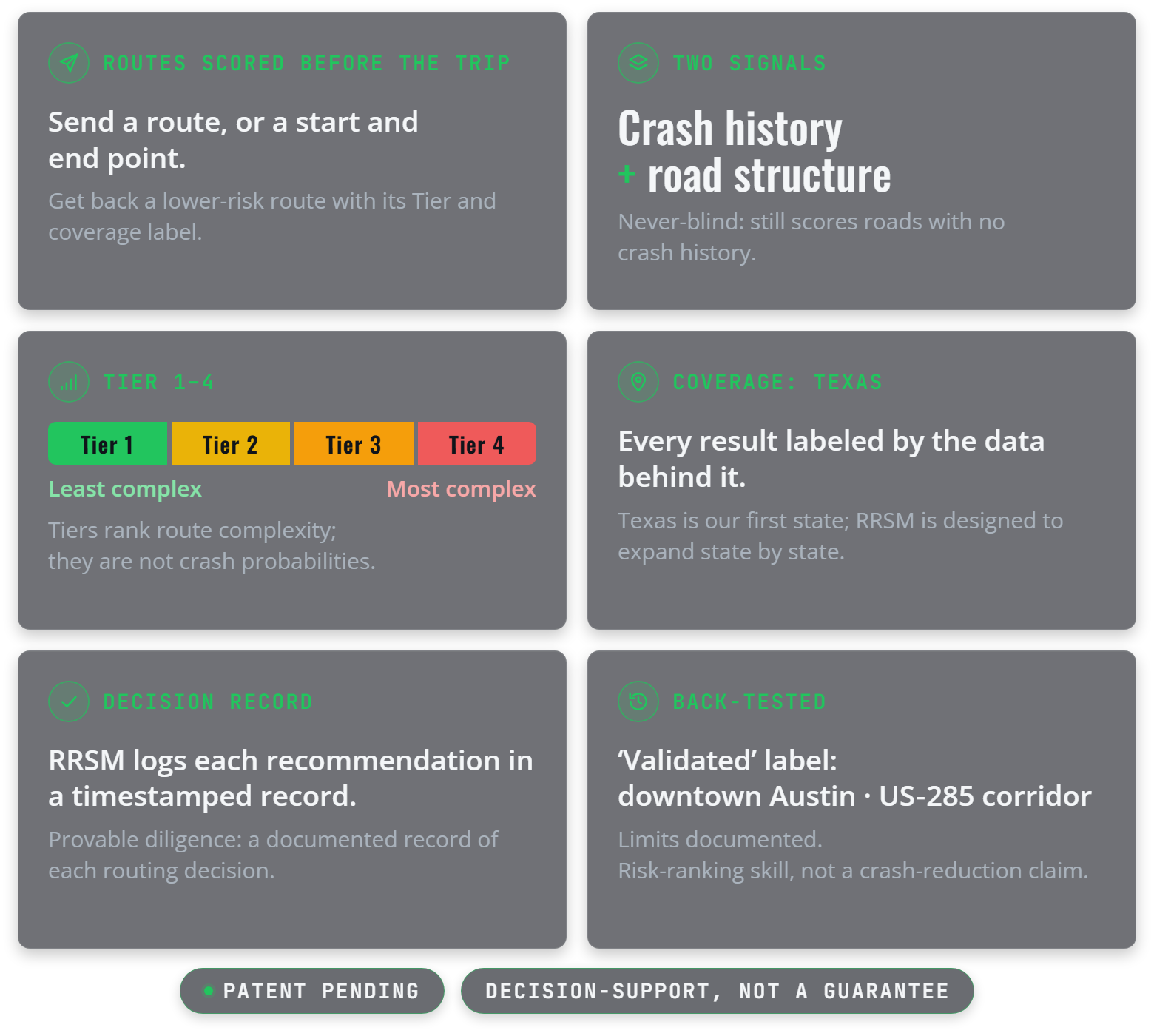
A two-signal score (crash history + road structure) that is never-blind — it still scores roads with no crash history — running today across Texas, with every result labeled by the data behind it.
Provider-agnostic, with no cloud-SDK lock-in. Send a route, or a start and end point; get back a lower-risk route with its Tier (1–4) and coverage label. Partners never receive the model. Integration details upon request; we set up a hosted connection when a partner signs.
Back-tested, not just claimed: in each Texas study region we test how well RRSM ranks road locations against fatal and serious-injury crashes held out from the data it was built on. Two regions — downtown Austin and the US-285 corridor — carry our ‘validated’ label, with their limits documented. Risk-ranking skill, not a crash-reduction claim.
Safe Ops℠ delivers a route and its Tier; your team owns coaching and the human in the loop. Safe Ops issues no driving protocol.



A route-risk signal, in three steps.
Send a route
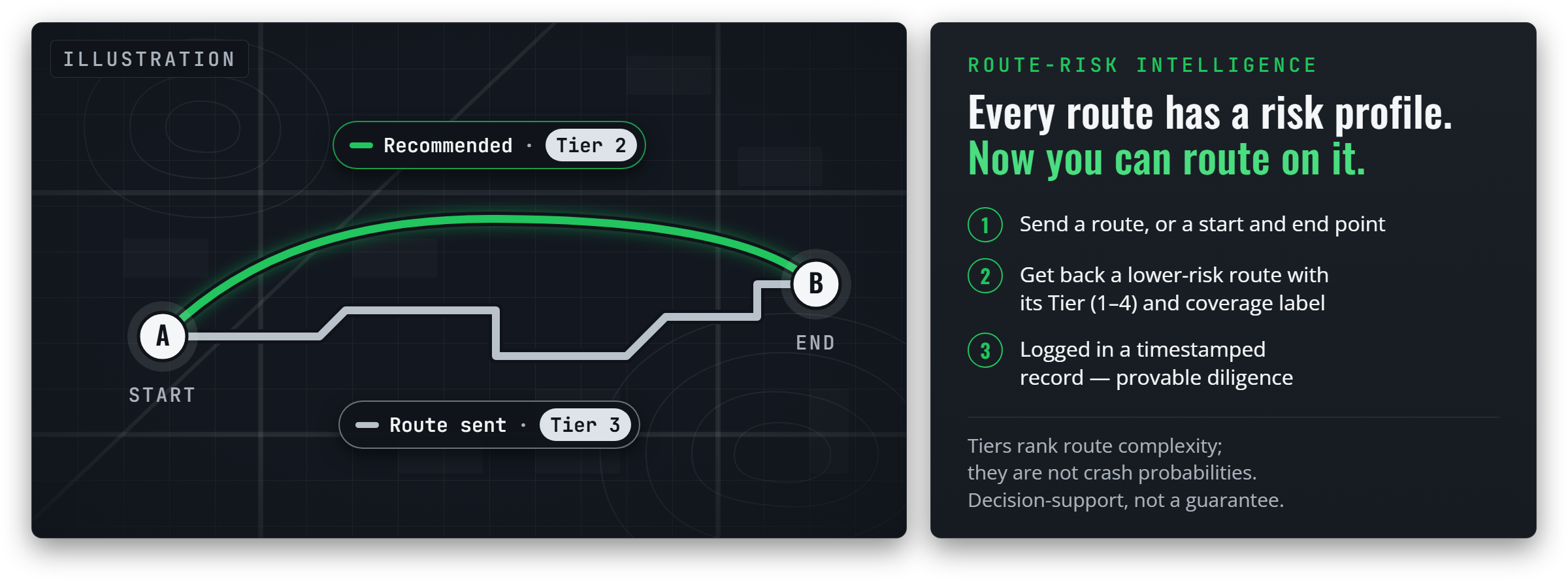
Send a route — or a start and end point — to RRSM.
RRSM scores it
It scores the candidate routes with a crash-history signal and a road-structure signal — never-blind — and recommends the lower-risk route with its Tier (1–4) and coverage label.
Log the recommendation
The prospective-prediction ledger writes a timestamped record — provable diligence.
Fleets
Lower-risk routing plus a documented record of each routing decision. Route with, and prove, diligence.
Insurers & brokers
A route-risk signal for underwriting, loss-prevention differentiation, and portfolio triage.
Mobility & telematics platforms
Built to embed via API and add a risk layer to your routing — provider-agnostic, no lock-in, available white-label.

Built by operators, tested against real crash records. Safe Ops was founded by Ben Sions and Matt P. Kelly on one insight — that route risk can be scored before the trip — now the patent-pending RRSM.
Meet the founders →